


Published on: July 17, 2026

The Vital Facts Every Floridian Should Know

As a resident of the Sunshine State, you are undoubtedly familiar with the rich biodiversity found throughout Florida, from its tropical forests to its sandy beaches. That biodiversity includes many microscopic organisms, but the mites that affect human skin require careful distinction. Some normally live on the skin without causing symptoms, while scabies mites cause a contagious infestation that requires proper diagnosis and treatment.

Scabies is one of the most common contagious skin infestations worldwide. It is caused by microscopic mites that burrow into human skin. People looking for reliable information often ask “what is scabies?”, “can mites live on humans?”, “how to kill mites on humans,” or “how to get rid of skin mites.” Recognizing the signs early can help reduce discomfort, limit transmission, and support faster treatment and recovery.

For Florida residents, especially people living in shared environments or caring for children, older adults, or immunocompromised family members, recognizing the symptoms of scabies and other skin mite problems is an important step toward protecting personal and public health.

Concerned about intense nighttime itching or an unexplained rash? Scabies can resemble several other skin conditions. Contact a qualified healthcare provider for an accurate diagnosis before attempting treatment.

Quick Answer: What Is Scabies?

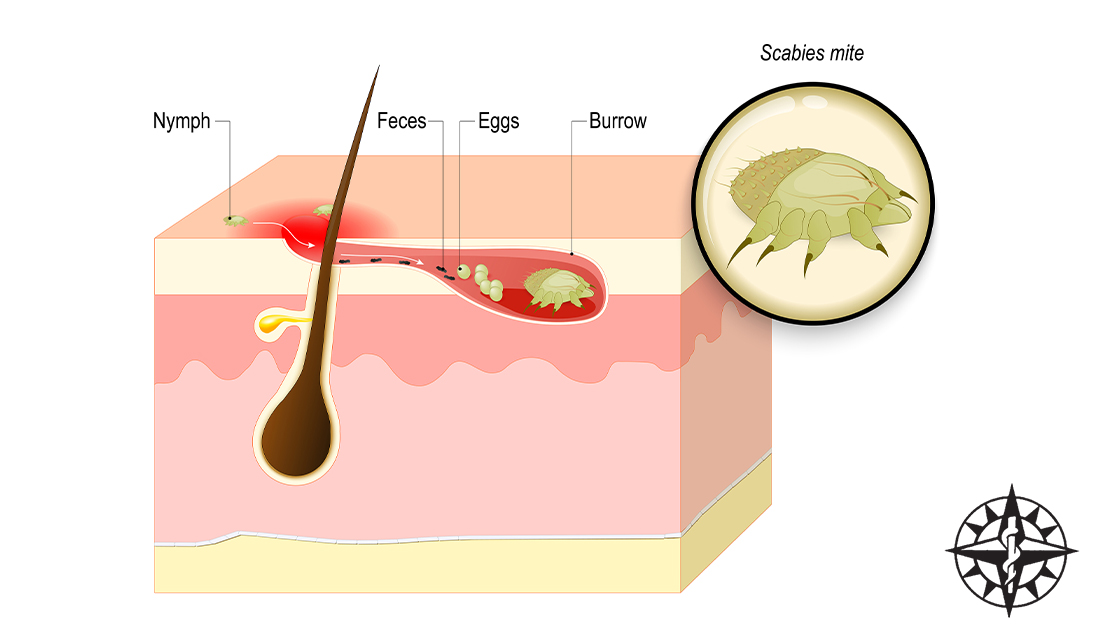
Scabies is a highly contagious skin infestation caused by the microscopic human itch mite known as Sarcoptes scabiei var. hominis. These scabies mites burrow into the upper layer of the skin, where they live and lay eggs. Common symptoms include severe itching, especially at night, a pimple-like rash, and thin burrow tracks. Professional medical treatment is usually required to eliminate the infestation and prevent reinfestation.

Scabies is not a sign of poor personal hygiene. Anyone can develop it after prolonged skin-to-skin contact with someone who has an active infestation.

Scabies and Skin Mites: A Brief History

Scabies and skin mites are not modern problems. They have affected humanity for centuries. References to scabies-like conditions date back to ancient times, and Hippocrates described an itchy skin condition that historians have associated with scabies. During World War II, infestations were also a significant concern in crowded military barracks and hospitals.

Today, medical researchers know that scabies is caused by an infestation of the skin by the human itch mite, Sarcoptes scabiei var. hominis. According to the Centers for Disease Control and Prevention’s overview of scabies, these microscopic eight-legged mites burrow into the upper layer of the skin, where they live and lay eggs.

Other types of skin mites, including Demodex, normally reside on many people’s skin without causing problems. In some individuals, however, an unusually high number of Demodex mites may contribute to a condition called demodicosis. This is different from scabies and requires a different diagnostic and treatment approach.

While people may casually use phrases such as “body mites,” “human mites,” “human skin mites,” “mites on human skin,” or “skin mites on humans,” scabies is a specific, medically recognized parasitic infestation. Without appropriate treatment, it can continue spreading through households, healthcare facilities, schools, nursing homes, and other close-contact environments.

Can Skin Mites Live on Humans?

Yes. Certain types of microscopic mites can live on human skin.

Some mites, such as Demodex, are naturally present on the skin of many healthy adults and usually do not cause symptoms. Scabies mites are different because they burrow into the upper layer of the skin and cause an immune reaction that can lead to intense itching, irritation, and a rash.

Scabies mites spread primarily through prolonged, direct skin-to-skin contact. In some situations, they may also spread through recently used bedding, towels, or clothing. This type of transmission is more likely in crowded environments and in cases of crusted scabies, where a person may have a much larger number of mites.

Are Scabies Mites the Same as Other Skin Mites?

No. “Skin mites” is a broad phrase rather than one specific medical diagnosis.

Type What It Means Typical Effect on Humans
Scabies mites Sarcoptes scabiei var. hominis mites that burrow into the upper skin Intense itching, rash, and possible burrow tracks
Demodex mites Mites that commonly live in hair follicles and oil glands Usually harmless but may contribute to demodicosis in some people
Animal mites Mites adapted to animals such as dogs or cats May temporarily irritate human skin but generally do not reproduce on humans like human scabies mites
Bed bugs Insects, not mites Bites may resemble a scabies rash but do not burrow into the skin
Lice Parasitic insects, not mites Live on hair or clothing and require different treatment

Searches for terms such as “mange in humans” or “can humans get mange” often reflect confusion between animal mite infestations and human scabies. Human scabies is caused by a human-adapted mite and should be evaluated and treated as its own condition.

Signs and Symptoms of Scabies and Skin Mite Infestations

Understanding the signs of scabies and other skin mite problems is essential for receiving prompt treatment and limiting transmission.

The CDC identifies intense itching and a pimple-like rash as the most common symptoms of scabies. Itching is often worse at night. The rash may affect much of the body or appear in characteristic locations, including between the fingers, around the wrists, on the elbows, in the armpits, around the waist, on the buttocks, around the nipples, or in the genital area.

The primary signs and symptoms of scabies include:

  1. Intense itching, especially at night: Itching is one of the most recognizable symptoms and may become increasingly severe over time.
  2. A pimple-like skin rash: Scabies may cause small, raised bumps or blisters. The appearance can vary depending on a person’s skin tone and immune response.
  3. Sores from scratching: Repeated scratching can break the skin. Open sores may become infected with bacteria.
  4. Thin, irregular burrow tracks: These tracks may look like short, raised, grayish, skin-colored, or reddish lines. They can be difficult to see and are commonly found in skin folds.
  5. Symptoms in specific areas of the body: Burrows and bumps often appear between the fingers, around the wrists, on the elbows, around the waistline, on the buttocks, around the nipples, on the knees, on the soles of the feet, or in the genital area.
  6. Itching that feels worse after heat exposure: Some people notice that warmth from a bed, bath, or shower makes the itching feel more intense.
  7. Signs of a secondary infection: Redness, warmth, swelling, tenderness, drainage, pus, fever, or increasing pain may indicate a bacterial infection that requires medical attention.

Infants and young children may have symptoms on the head, face, neck, palms, and soles. Older adults and people with weakened immune systems may develop less typical symptoms or crusted scabies, a severe form that can involve thick, crusted areas of skin and a very large number of mites.

Other skin mite conditions, such as demodicosis, may cause redness, rough or flaky skin, burning, itching, or irritation around hair follicles. Many people with Demodex mites have no symptoms at all. In humans, the appropriate medical term for disease associated with an excessive number of these mites is generally demodicosis, rather than demodectic mange.

What Does a Scabies Rash Look Like?

A scabies rash may appear as tiny raised bumps, pimple-like lesions, small blisters, or irritated patches. Some people notice thin gray, reddish, or skin-colored burrow lines where female mites have tunneled into the upper layer of the skin.

The appearance of the rash can differ across skin tones. Redness may be less visible on darker skin, while bumps, changes in texture, scratching, or darkened areas may be more noticeable.

Scabies symptoms can resemble eczema, allergic reactions, contact dermatitis, folliculitis, bed bug bites, or other skin conditions. A photograph alone may not be enough to confirm the cause. Professional evaluation is often necessary for an accurate diagnosis.

How Soon Do Scabies Symptoms Appear?

When someone develops scabies for the first time, symptoms may not appear for several weeks. A person can still spread the infestation during this period even if itching or a rash has not started.

People who have had scabies before may develop symptoms much sooner after another exposure. This is one reason household members and other close contacts should follow a healthcare provider’s instructions even when they do not have symptoms.

How Scabies Spreads

Scabies most commonly spreads through direct, prolonged skin-to-skin contact with a person who has the infestation. A brief handshake or quick hug is less likely to transmit typical scabies than sustained close contact.

Transmission may occur among:

  • Household members
  • Intimate partners
  • Caregivers and patients
  • Children and staff in childcare environments
  • Residents and workers in nursing homes
  • People living in shelters, group homes, dormitories, or correctional facilities

Scabies can sometimes spread through recently used clothing, towels, or bedding. This route is less common in ordinary scabies but can be more important in crusted scabies.

Can Scabies Spread from Person to Person Before Symptoms Begin?

Yes. Someone with scabies can transmit the mites before developing noticeable symptoms. With a first infestation, the immune reaction that causes itching and a rash may take several weeks to appear.

Anyone who has had prolonged skin-to-skin contact with a person diagnosed with scabies should ask a healthcare provider whether evaluation or simultaneous treatment is needed.

Can You Get Scabies from Pets?

Human scabies is caused by a mite adapted to humans. Dogs, cats, and other animals can develop infestations from different mite varieties. Animal mites may occasionally cause temporary itching or irritation in people, but they generally do not survive and reproduce on humans in the same way as the human scabies mite.

If both a person and a pet have skin symptoms, consult a healthcare provider and a veterinarian rather than using human medication on an animal or veterinary medication on a person.

How Doctors Diagnose Scabies

Healthcare providers typically diagnose scabies by reviewing symptoms, examining the distribution of the rash, checking for burrows, and asking about possible exposure.

In some cases, a provider may use dermoscopy or collect a small skin scraping. The sample can be examined under a microscope for a mite, egg, or fecal material. A negative scraping does not always rule out scabies because a person with ordinary scabies may have relatively few mites.

Prompt diagnosis is important because an untreated infestation may continue spreading to family members, intimate partners, healthcare workers, and people in communal living environments.

Scabies Versus Other Itchy Skin Conditions

Feature Scabies Eczema or Dermatitis Bed Bug Bites Demodicosis
Cause Human itch mite Skin inflammation or an allergic or irritant response Bites from insects Excessive Demodex activity associated with symptoms
Contagious Yes No Bites do not spread from person to person Generally not treated as a contagious infestation like scabies
Itching at night Common Possible Possible Possible
Burrow tracks May be present Absent Absent Absent
Common locations Finger webs, wrists, waist, buttocks, genital area, and skin folds Varies Exposed skin Often facial areas and hair follicles
Treatment Clinician-directed scabicide Depends on the cause Pest control and symptom care Clinician-directed treatment when symptomatic

Not sure whether your symptoms are caused by scabies? A medical evaluation can help distinguish scabies from dermatitis, allergic reactions, insect bites, bacterial infections, and other causes of persistent itching.

How to Get Rid of Mites on Humans

People searching for “how to kill mites on humans,” “how to get rid of mites on humans,” “how to get rid of mites on body,” or “treatment for mites” should understand that treatment depends on the exact organism involved. There is no single safe home remedy or product for every type of skin mite.

For scabies, clinician-directed medication is normally necessary. Over-the-counter products intended for lice do not reliably treat scabies. Household sprays, insecticides, bleach, cleaning chemicals, or veterinary medications should never be applied to the skin.

Treatment Options for Scabies Mites

If you suspect a scabies or skin mite infestation, seek medical attention. A healthcare provider can determine whether the symptoms are caused by scabies and select an appropriate treatment based on factors such as age, pregnancy status, medical history, symptom severity, and immune health.

According to the CDC’s scabies treatment guidance, prescription scabicides are used to kill scabies mites. Treatment may involve a topical medication, an oral medication, or a combination of treatments in severe cases. Permethrin cream and oral ivermectin are among the options a healthcare provider may consider.

The directions depend on the prescribed medication. Some topical treatments are applied over much of the body and left on for a specified period before being washed off. Infants, older adults, immunocompromised patients, and people with crusted scabies may require different application instructions or a more intensive treatment plan.

Some medications may not destroy every egg with one application. A clinician may recommend repeat treatment at a specific interval to address newly hatched mites. Follow the complete treatment plan even if the itching begins to improve.

A healthcare provider may also recommend medication or supportive care to help manage itching. Treatments that relieve itching do not necessarily kill scabies mites.

Lindane has historically been used for scabies, but it has important safety limitations and is not appropriate for many patients. It should not be used unless it is specifically prescribed after a healthcare professional evaluates the risks and available alternatives.

Treatment for Other Skin Mites

Skin mite conditions other than scabies require a different approach. Symptomatic demodicosis, for example, may be treated with topical or oral medication chosen by a qualified healthcare provider. Treating presumed skin mites without confirming the cause may delay care for eczema, rosacea, dermatitis, folliculitis, bacterial infection, or another condition.

Many people searching for “medicine for skin mites” or “mites on humans treatment” may attempt home remedies first. Professional diagnosis is important because incomplete or incorrect treatment can allow scabies to continue spreading or make another skin condition worse.

How to Prevent Scabies from Spreading

Preventing scabies transmission requires appropriate medical treatment, coordinated care for exposed contacts, and targeted handling of recently used personal items.

The CDC’s scabies prevention recommendations include treating household members and close contacts at the same time as the person with scabies when directed by a healthcare provider.

Recommended precautions may include:

  1. Complete the prescribed treatment exactly as directed.
  2. Ask whether household members, intimate partners, or other close contacts need simultaneous treatment.
  3. Avoid direct skin-to-skin contact until the treatment plan allows normal contact to resume.
  4. Wash clothing, towels, and bedding used during the three days before treatment in hot water.
  5. Dry washable items using a hot drying cycle or have appropriate items dry-cleaned.
  6. Seal items that cannot be washed or dry-cleaned in a closed plastic bag for several days to one week.
  7. Avoid sharing bedding, clothing, and towels until treatment and cleaning steps are complete.
  8. Follow facility-specific infection-control procedures when an exposure occurs in a nursing home, hospital, childcare center, shelter, or other group environment.

Scabies mites usually do not survive away from human skin for more than a few days. Extensive pesticide treatment of a home is generally unnecessary for ordinary scabies. Focus on the treatment and cleaning instructions provided by a healthcare professional.

Can Scabies Mites Live in a Mattress?

Scabies mites may survive briefly away from human skin, including on recently used bedding or clothing. They do not normally establish a permanent colony inside a mattress.

Follow current medical guidance for laundering recently used sheets, pillowcases, clothing, and towels. Vacuuming may be considered in some environments, particularly with crusted scabies, but spraying a mattress or home with insecticide is not a substitute for treating affected people and their close contacts.

Why Itching Can Continue After Treatment

Itching may continue for several weeks after successful scabies treatment. This does not always mean that live mites remain or that treatment failed. The body can continue reacting to mite material and inflammation after the infestation has been treated.

Contact a healthcare provider if:

  • New burrows or new rash areas appear
  • Itching becomes worse instead of gradually improving
  • Symptoms continue beyond the expected recovery period
  • Treatment instructions were not completed
  • Household members or close contacts develop symptoms
  • Skin becomes increasingly painful, warm, swollen, or produces drainage

A clinician can determine whether the symptoms reflect post-scabetic itching, reinfestation, incomplete treatment, an incorrect diagnosis, or another skin condition.

Preventing Scabies and Skin Mite Problems in Florida

Education is an important part of preventing scabies transmission in Florida. Scabies can affect anyone and is not caused by poor hygiene. Regular hygiene may support general skin health, but bathing more frequently cannot prevent or cure an infestation acquired through close contact.

The most effective preventive steps are recognizing symptoms, avoiding prolonged contact during an active infestation, completing clinician-directed treatment, treating exposed close contacts when instructed, and appropriately handling recently used clothing and bedding.

Although anyone can get scabies, certain groups face a greater risk of exposure, delayed diagnosis, or severe disease. These include:

  • Older adults
  • Infants and young children
  • People with weakened immune systems
  • Residents and workers in nursing homes
  • People in hospitals or extended-care facilities
  • Children and staff in daycare environments
  • People living in crowded or communal settings

Do not panic if you or someone you care for develops scabies. It is not a reflection of cleanliness or lifestyle. It is a treatable infestation that has affected people throughout human history. With accurate information, coordinated treatment, and appropriate medical care, most infestations can be successfully managed.

Florida’s diverse environment includes organisms of every size, from dolphins in coastal waters to microscopic mites. Understanding which mites normally coexist with humans and which cause disease helps residents respond calmly, protect their households, and seek appropriate treatment.

When Should You See a Doctor for Scabies?

Seek medical attention if:

  • Itching becomes severe or persistent
  • A rash spreads rapidly
  • Sores become painful, warm, swollen, or infected
  • Symptoms affect multiple household members
  • New burrows appear after treatment
  • Symptoms continue or recur after treatment
  • The affected person is an infant, an older adult, pregnant, or immunocompromised
  • Thick or crusted areas develop
  • You are unsure whether the condition is scabies
  • Over-the-counter products or home remedies have failed to help

Crusted scabies requires prompt medical attention. This severe and highly contagious form is more likely to affect older adults and people with weakened immune systems.

An infectious disease specialist can help determine whether symptoms are caused by scabies, another type of skin mite, an allergic condition, a bacterial infection, or another skin disorder.

Scabies and Skin Mite Care in Tampa Bay

People in Tampa, Wesley Chapel, and surrounding Tampa Bay communities who experience persistent itching, unexplained rashes, or symptoms that may be related to scabies or skin mites should seek an accurate diagnosis. Early treatment can reduce discomfort, limit transmission, and protect household members and close contacts.

Patients throughout the region trust the experienced team at Infectious Disease Associates of Tampa Bay (IDATB) for compassionate, specialized infectious disease care.

Need help with persistent or recurring symptoms? Call IDATB at 813-251-8444 to ask about available care and whether a referral is required.

Wrapping Up: Knowledge Is the First Line of Defense

The history of human scabies and skin mites extends back centuries, but modern medicine provides effective ways to diagnose, treat, and prevent these infestations. Recognizing nighttime itching, a pimple-like rash, and possible burrow tracks can help people seek care sooner.

Having scabies or another skin mite condition is not a reflection of a person’s cleanliness or lifestyle. Floridians, like people everywhere, may encounter these parasites. Appropriate medical treatment and coordinated care for close contacts provide the best path toward recovery.

Early detection can reduce discomfort and help prevent further transmission. Do not hesitate to consult a healthcare provider if you notice symptoms associated with scabies or another suspected skin infestation. These conditions are treatable and manageable with timely, medically appropriate care.

Sharing reliable information can also help prevent outbreaks. Families, caregivers, schools, healthcare facilities, and communal living environments benefit when people understand how scabies spreads and know when to request professional care.

In our shared Florida home, we live alongside organisms of every size. Understanding the difference between harmless skin organisms and mites that cause disease helps us protect our health while respecting the interconnected natural environment around us.

Get Expert Help for Scabies and Skin Mite Concerns

If you are experiencing persistent itching, an unexplained rash, recurring symptoms, or signs that may be related to scabies or skin mites, professional diagnosis is important. Early treatment can help reduce discomfort, prevent transmission, and protect your household and close contacts.

The experienced providers at IDATB offer specialized infectious disease care for patients throughout the Tampa Bay region.

About Infectious Disease Associates of Tampa Bay

IDATB is dedicated to providing exceptional healthcare services to individuals throughout the Tampa Bay region. With a history spanning more than three decades, the practice serves the community through specialized care for infectious diseases. Its comprehensive approach is supported by an on-site laboratory that assists with timely testing when clinically appropriate.

If you have questions or concerns related to scabies or another infectious condition, call 813-251-8444. IDATB’s healthcare professionals are committed to delivering personalized care and helping patients make informed decisions about their health.

When an in-person visit is not feasible or necessary, virtual care may be available through IDATB’s Telehealth system. Contact the practice to ask whether telehealth is appropriate for your symptoms and circumstances.

Frequently Asked Questions

What Are the First Signs of Scabies in Humans?

The earliest signs often include intense itching, especially at night, and small bumps or rash-like irritation. Some people also notice thin burrow lines where mites have tunneled into the upper skin. After a person’s first exposure, these symptoms may take several weeks to appear.

How Contagious Is Scabies?

Scabies is highly contagious and most commonly spreads through prolonged skin-to-skin contact. It can also spread through recently used bedding, towels, or clothing in some situations. A person may transmit scabies before developing symptoms, so close contacts may need simultaneous treatment.

Can Skin Mites Live in Mattresses and Bedding?

Scabies mites can survive temporarily on recently used bedding, clothing, and towels, but they typically survive away from human skin for only a few days. They do not normally establish a permanent infestation inside a mattress. Follow healthcare guidance for laundering or isolating recently used items.

Can Scabies Go Away Without Treatment?

Scabies usually does not go away on its own. Without effective treatment, the mites may continue reproducing and spreading to other people. Scabies generally requires a clinician-recommended medication rather than a home remedy or over-the-counter lice treatment.

What Kills Scabies Mites Quickly?

Prescription scabicides, including treatments such as permethrin cream or oral ivermectin, may be used to treat scabies. The appropriate medication and schedule depend on the patient. A healthcare provider should confirm the diagnosis and select the safest treatment rather than relying on household chemicals or veterinary products.

How Do You Get Rid of Mites on Humans?

The correct approach depends on the type of mite. Scabies usually requires prescription treatment, coordinated treatment of close contacts, and laundering or isolating recently used personal items. Other skin mite conditions require different care, so an accurate diagnosis should come before treatment.

Do Household Members Need Scabies Treatment?

Household members and other close contacts are often treated at the same time, even if they do not yet have symptoms. This helps prevent reinfestation and continued transmission. A healthcare provider should identify which contacts need treatment and explain when it should begin.

How Long Can Scabies Live Off the Body?

Scabies mites generally survive away from human skin for only a few days. Items used shortly before treatment may still require laundering, hot drying, dry-cleaning, or temporary isolation in a sealed bag. Follow CDC prevention guidance and your provider’s instructions.

Can Humans Get Scabies from Dogs or Cats?

Animal mites may temporarily irritate human skin, but they generally do not reproduce on people like the human scabies mite. Human scabies usually spreads from another person. If both a person and a pet have symptoms, consult a healthcare provider and veterinarian.

What Is Crusted Scabies?

Crusted scabies is a severe form that may involve thick, crusted skin and hundreds of thousands or millions of mites. It is extremely contagious and is more common in older adults and people with weakened immune systems. Suspected crusted scabies requires prompt professional treatment.

Why Does Itching Continue After Scabies Treatment?

Itching may continue for several weeks after successful treatment because the immune system is still reacting to inflammation and mite debris. Persistent itching alone does not always mean treatment failed. New burrows, new bumps, worsening symptoms, or affected close contacts warrant follow-up evaluation.

When Should You See a Specialist for Scabies Symptoms?

Seek medical evaluation if symptoms are severe, spread rapidly, recur after treatment, affect multiple household members, or occur in an immunocompromised person. Professional diagnosis can confirm scabies, identify complications, and rule out other conditions that may look similar.

Can Scratching a Scabies Rash Cause an Infection?

Yes. Repeated scratching can break the skin and allow bacteria to enter. Increasing pain, warmth, swelling, spreading redness, drainage, pus, or fever may indicate a secondary bacterial infection and should be evaluated by a healthcare professional.

How Can You Tell Scabies from Eczema or Bed Bug Bites?

Scabies commonly causes intense nighttime itching, affects characteristic areas such as finger webs and wrists, and may produce thin burrow tracks. Eczema and bed bug bites can look similar but have different causes and treatments. A physical examination may be needed to distinguish them accurately.

Medical References